
It was inevitable that in time, the Firstborn, quickened by such surroundings as the Valley of the Creator, would begin to ask why.
Why did the sun’s path change in the sky with the passing of many days? Why did some fruits fill the belly with strength while others made the stomach grip with pain? Why did the river sometimes swell without rain?
The Creator did not answer each question with a direct word. Instead, he allowed, (or as some believe) arranged occasions of discovery.
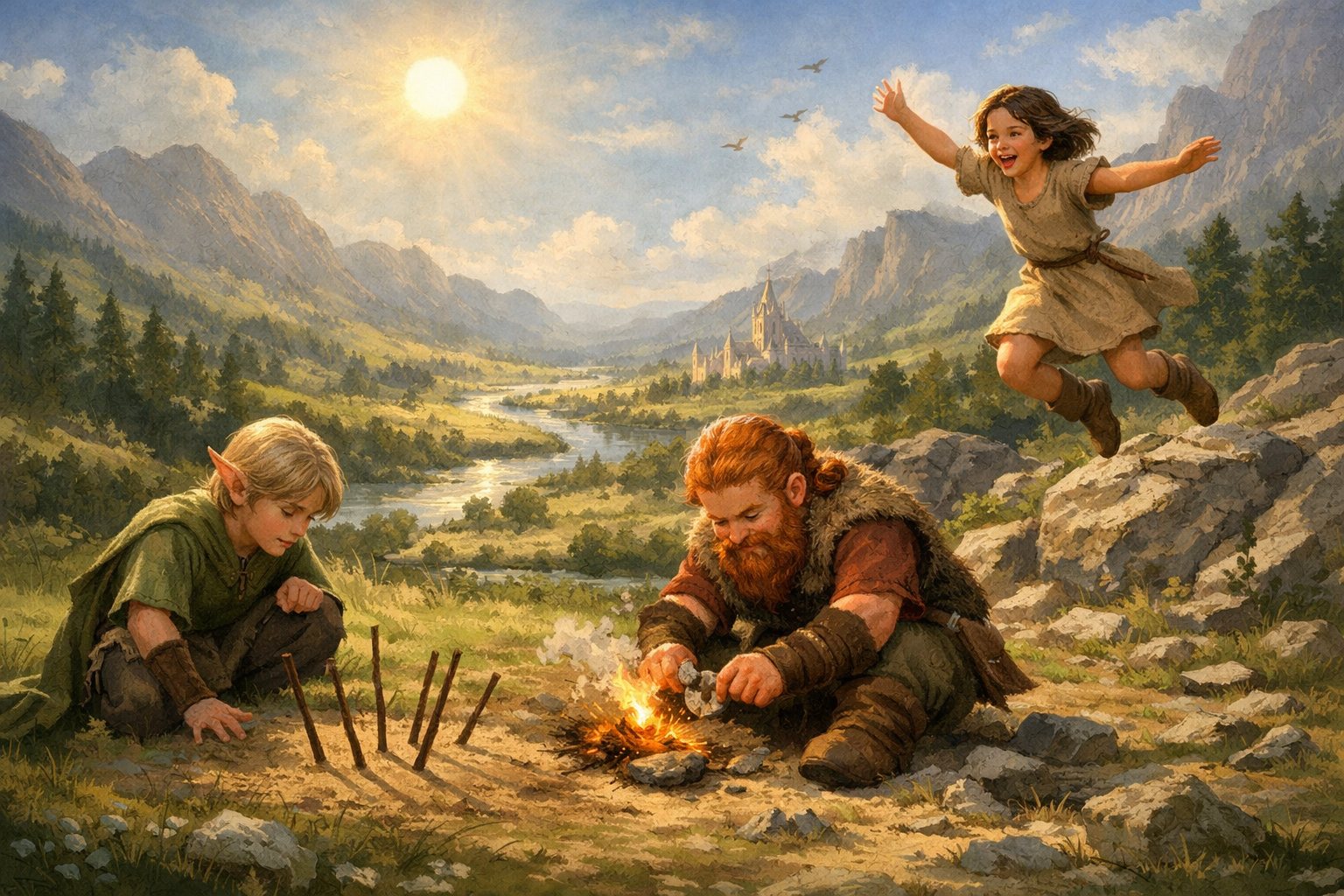
An elven child, puzzled by the way shadows moved, set sticks in the ground and returned to them through the day, noting the angles they cast. A dwarven youth, curious about spark and heat, struck certain stones together and learned which would kindle dry grass. A human girl, watching birds rise and fall on the wind, began to play at leaping from rocks with her arms spread, and learned as much from her tumbles as from her brief moments of lift.
In later Ages, we would call such things experiments, and would codify them in treatises and guild lessons. In the Valley, they were simply santified play.
It was also in the Valley, Dreamers say, that the first ideas of travel entered the hearts of the Firstborn.
For while the Creator’s nearness could be sensed (in the warmth of light at certain gatherings, in the sudden ease of a task that should have been hard, in the face of a kind story-teller), he did not walk among his children as one of them day to day. They did not yet see him in a single face, or hear him in a single voice that could be pointed to and named.
Some among the Firstborn began to feel a desire to go beyond the hills and see what lay on the other side.
Here, I think, lie the seeds of many later stories. But those tales belong to other Ages. For now, in our reckoning, we remain at the end of the first hundred years: the Age of Creation closing like a slowly drawn breath, the Valley of the Creator still green and whole, the Firstborn still dwelling together in a harmony we, their heirs, can scarcely imagine.
What prompted them at last to step beyond that circle of hills? To strike out for forests and mountains and plains? To claim lands as their own rather than as a shared gift? I shall recount that tale in the history of the Age of Exploration.
There, we’ll first see the word “mine” set against “yours,” and learn how swiftly wonder can turn to rivalry when boundaries widen and the Creator’s nearness feels less keen.
For now, it is enough to remember that once, for a brief, bright span, all peoples lived as neighbors without fear, and that the world itself was their first and only temple.

Leave a Reply