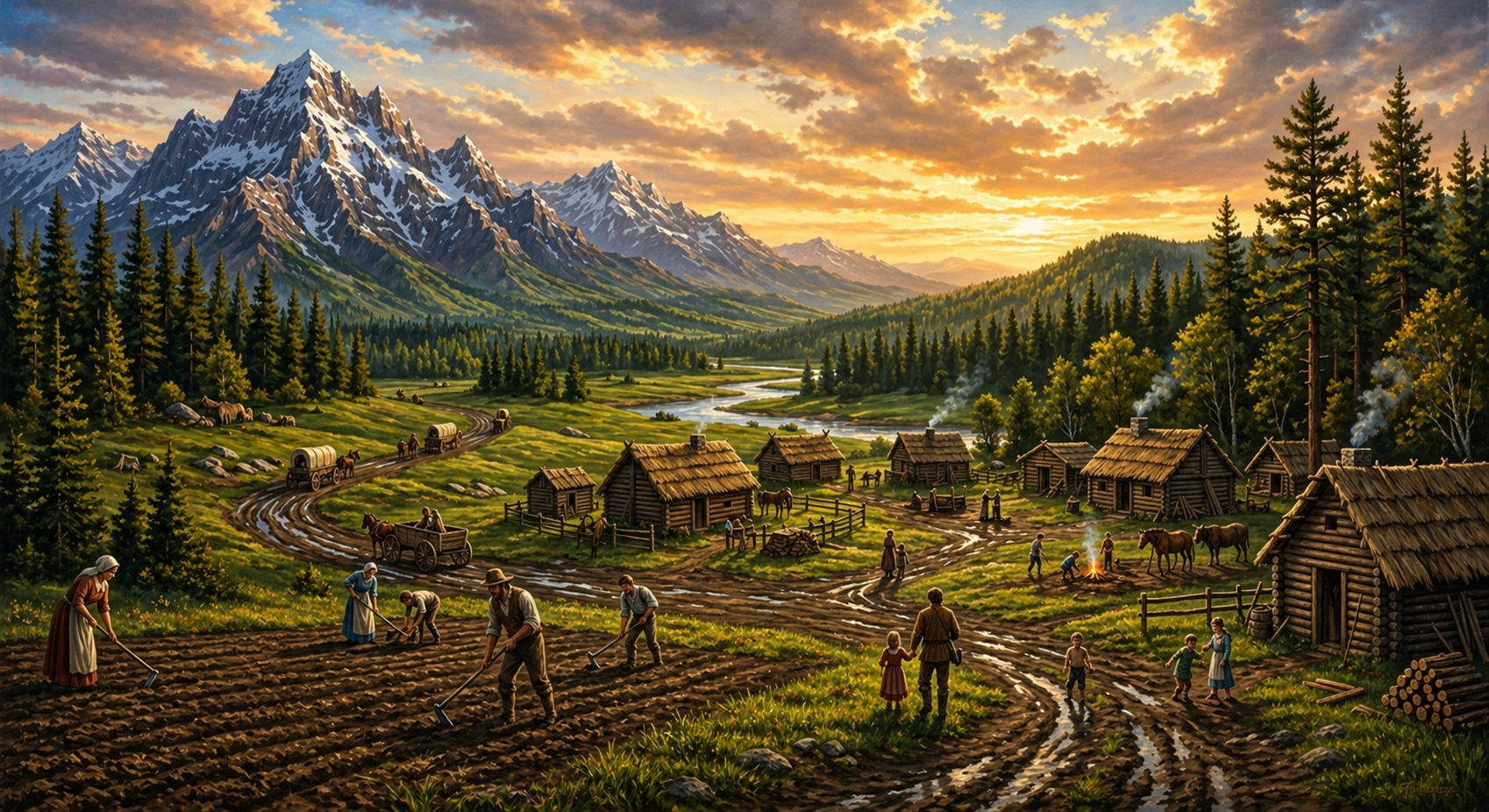
Of all the races, it was arguably the Humans who first pressed beyond the valley’s bounds with unyielding determination, driven by a fire to claim and cultivate the land.
Their lore speaks of Tristaf the Wanderer—his journals, passed down through generations, recounting the slow and bitter struggle through the cold passes of the Argulron Mountains. Tristaf’s party, numbering no more than forty at the start, dwindled under the trials of avalanches, hunger, and piercing winds. Yet maps drawn in charcoal and scraps of fabric marked with crude landmarks bear witness to their resolve.
On the far side of the mountains, new land stretched before them: rolling hills and dense forest shot through with rivers overflowing with meltwater. It was here, in the lands east beyond the Argulron range, that the early Human pioneers drove their stakes.
These first settlers built homes of cut pine and thatched reed, forming the earliest hamlets of what would become Norstok. No grand decree announced its founding. Instead, claim was established the Human way: a boundary stone sunk into the earth, a field tilled, a hearth kindled, and children playing in the falling dusk.
In time, trade trails forged by boots became wagon tracks. Wagon tracks became sturdy roads connecting farms and growing settlements. Human ingenuity flourished as they bartered with passing Dwarves and traveling Elves, exchanging smoked meats, woven goods, and hard-won knowledge of the land’s seasons.
Norstok, named for the legend of Nor the Elder who first caught sight of the eastern sunrise from the Ridge of Many Pines (known today as the Broken Byway), began to see itself not as an outpost, but as a rising nation.
From the lush Valley of the Creator through trecherous mountain passes to fertile plains, the Human march had claimed its first true homeland.
Next week, we’ll continue eastward as we voyage with the Elves.

Leave a Reply