
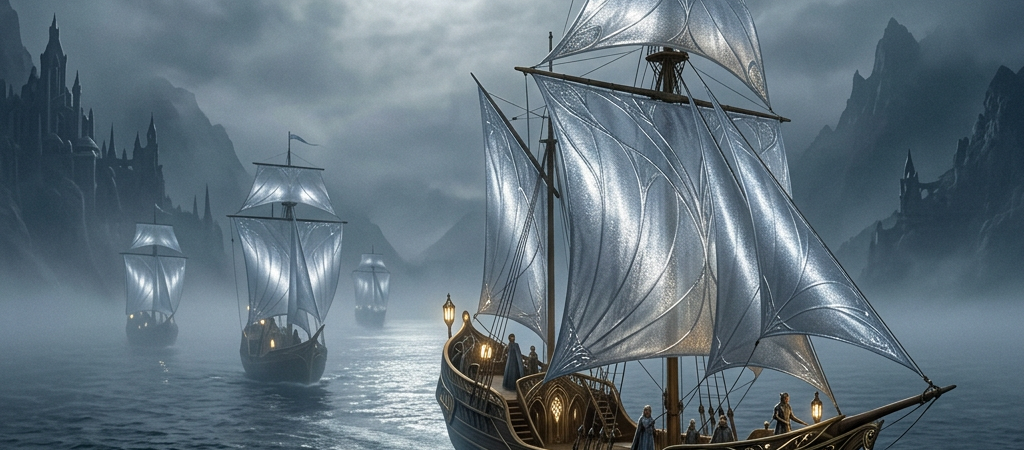
While the Humans staked their claim inland, the Elves found their gaze drawn ever eastward, toward the hazy silhouette of a distant wood glimpsed across choppy waters.
Elven council records tell of the first Elven Queen, Lirael, who led the first crossing in crafted skiffs. When these pioneers came ashore upon a forested coast singing with new birdsong, they named the land Eskandor, a word said to mean “echo of hope.” Here, the Elves found a mesmerizing hum beneath the surface, as if the land itself welcomed them.
They raised great cities unlike any before—dwellings strung between boles as old as the world, bridges grown rather than built, and shrines to Bhava inscribed upon living bark.
Eskandor swiftly became the soul of the Elven people. Arts and learning prospered and the court of the Queen flourished. Early records detail the fostering of trade with Human and Dwarven neighbors, ferried across the Maridel Strait, bearing precious oils, intricately woven cloth, and medicinal herbs in exchange for crafted blades and rare minerals.
The Elven tongue, already known for its poetic sound, grew rich with borrowed words—a testament to this early spirit of exchange.
Across perilous waters, the Elves found not only new lands but a deeper harmony with the living world.