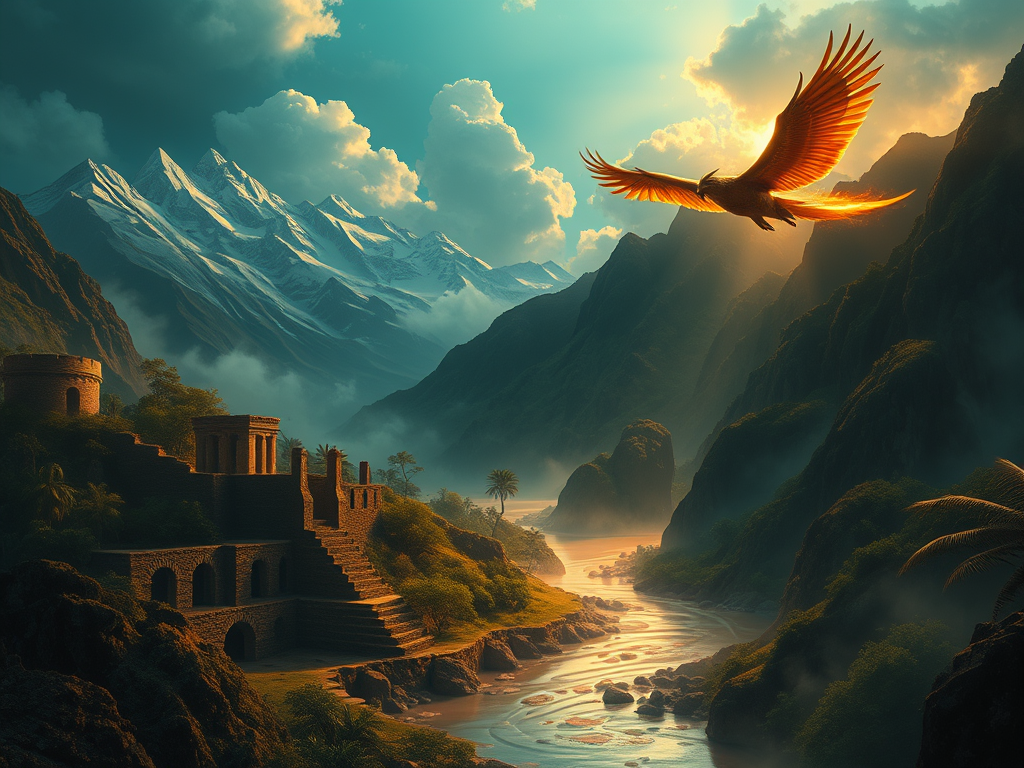

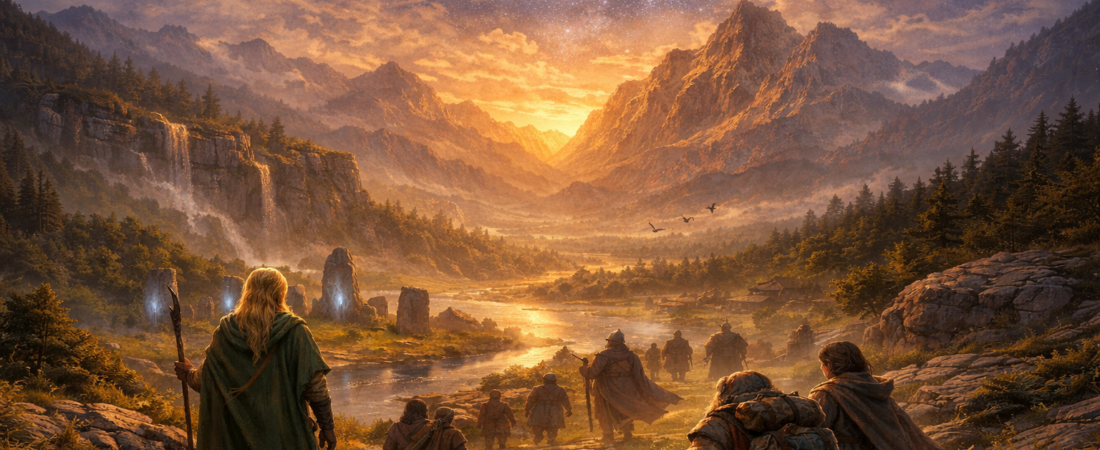
The Valley of the Creator was not fashioned as a final home. It was nursery, not a nation; a hearth where first words could be spoken and first trust learned. Yet even the gentlest hearth must one day be left, if its children are to grow into what they were meant to be.
By our reckoning, it is near the close of the hundredth year after the Firstborn were shaped that the next great turning comes: the leaving of the Valley and the beginning of the Age of Exploration.
How and why that departure occurred is told in many ways. I will not claim to know every step, but I will gather here what our oldest Dream‑visions, ancient records, and rith’yar and dwarven memories agree upon.
The Dreamers say there came a season when the air of the Valley felt thinner. The grass still grew strong; the river still ran clear. No blight marred the trees. Yet certain small signs changed.
The standing stones by the river’s bend warmed less often with that quiet, invisible presence they had known. Birds that once flocked within the Valley began to wheel beyond the passes and not always return. At night, the stars seemed to burn more fiercely at the horizons, as if to beckon eyes away from the green hollow and toward the greater dark.
The Creator had not abandoned his children; his law still held, his Life Current still pulsed in root and blood. But he had drawn back the immediacy of his nearness, as a parent loosens a steadying hand from a child’s first steps.
We have, in the Grand Athenaeum’s deep vaults, a fragment of testimony that speaks of this time. Translated into common speech, it runs:
“The Breath did not still. It widened.
He let the world be held more by its own weight.
His gaze was no less upon it, but less pressed into it.”
However phrased, the result was the same: the Firstborn began to feel not only that ache of restlessnesss which all mortals carry.
If the Valley was no longer a place where the Creator’s care might be known, then perhaps the hills beyond, and the lands beyond those hills, were not forbidden ground but instead an invitation to seek him elsewhere.
We like to tell ourselves that the Firstborn left the Valley hand in hand, all in one accord. The truth, as far as it can be known, is more tangled.
The humans were the first to chafe against the encircling ridges. Their quickening blood and short span made them keenly aware of the wider world hinted at by changes of wind and cloud. Some among them began to speak, half in jest and half in longing, of “other valleys” and “bigger skies.”
The dwarves, feeling the mountains’ deep pull through the soles of their feet, found themselves pausing more and more often at the mountain passes, their hands resting on the rocks as if in greeting to kin not yet met. They would bring back certain stones, different from any in the Valley, and turn them over and over in their hands, thoughtful.
The elves, whose hearts were slower to rouse but deeper to run, began to dream—sometimes waking, sometimes in sleep—of great forests beyond the hills, where starlight would fall in columns between trunks older than any sapling in the Valley. The idea of a wood they might tend as their own began to take root.
The rith’yar, watching and listening, felt these stirrings as a healer feels the first signs of a fever. They loved the Valley dearly and were slow to desire its leaving, yet they also sensed that the balance within that small hollow could not hold forever. Too many questions pressed outward; too many gifts lay waiting in lands untrod.
So it was that each people, in its own way, began to think not only of “ours” together, but of “ours” in particular: our mountains, our forests, our plains, our groves.
The word itself is not evil. Without it, there would be no care, no sense of rooted duty. But from that same syllable, another soon grew: “mine”—and the shadows of all later quarrels stir faintly even here.
The Counsel at the Standing Stones
Elven memory holds that, before any people set foot beyond the passes, there was a great counsel at the circle of stones by the river.
Whether it happened in a single day, or over many gatherings, we do not know. Our songs compress and adorn what was surely a longer, messier conversation. But the heart of it is this: the Firstborn spoke honestly of their differing callings, and of their fear that to obey those callings would mean leaving the safety of the Valley.
One of the oldest records in the Grand Athenaeum is an accounting set down many years after the event which has the dwarven elder saying:
“If I do not heed the mountains’ call in my bones, I will wither like a stone left in bad fire. Better to go and risk breaking than to stay and rot unshaped.”
A human woman is said to have answered:
“If we never go beyond these hills, we will always be children. Let some of us go and find the wide lands, and some stay and keep the hearth. The Creator can be met in both.”
An elven voice, perhaps the first of the line that would one day rule Eskandor, is recorded as saying:
“We will not stop being kindred because we root in different soils. Let us promise to remember one another, and to meet when we can under open sky.”
The rith’yar did not speak much, if the songs are to be believed. One of them laid a hand upon the standing stone and simply said:
“Where the Creator goes, the Life Current goes. We will follow where it leads.”
Whether those words were prophecy or simple trust, I leave to others.
What matters for our purposes is that the Firstborn did not erupt from the Valley in scattered panic, nor were they driven out by plague or punishment. They chose to go, pulled by desire and called by gifts, under the lingering care of the Creator.